
Creating Leaderboards and Rankings for Your Sports Community

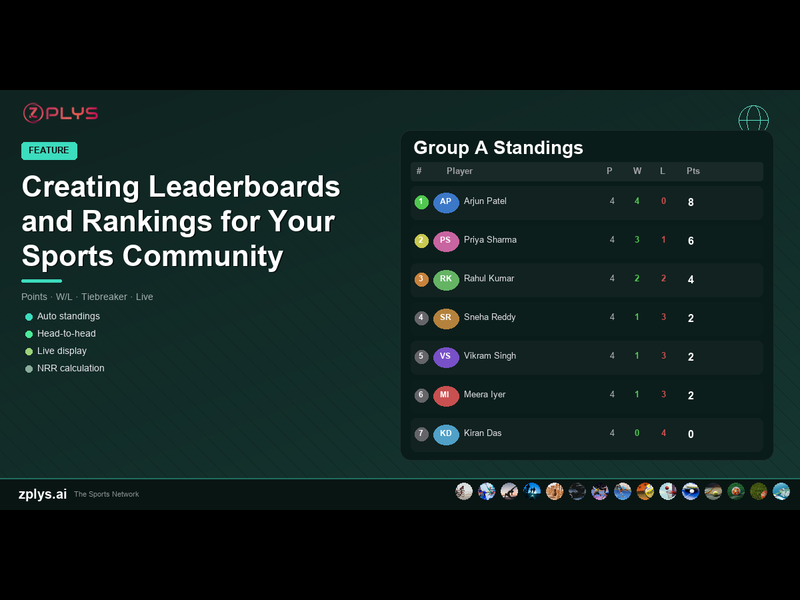
The Motivation Machine
There's a badminton club in Koramangala, Bengaluru, that went from 15 active members to 45 in six months. They didn't change their coaching, their courts, or their pricing. They added a leaderboard.
A simple ranking system - updated weekly, displayed on a WhatsApp group and a screen at the club - transformed casual players into regulars. Members who used to play "whenever" started showing up three times a week to protect their ranking. New members joined specifically because the ranking system made the club feel competitive and structured.
Leaderboards work because they tap into something fundamental: people want to know where they stand.
Choosing a Ranking System
Not all ranking systems are equal. The right choice depends on your sport, community size, and how often matches happen.
Points-Based Rankings
The simplest system: assign points for wins, draws, and losses. Rank by total points.
- ●Win: 3 points
- ●Draw: 1 point
- ●Loss: 0 points
- ●Bonus point for exceptional performance (e.g., century in cricket, hat-trick in football)
**Best for:** League formats with fixed schedules, where everyone plays roughly the same number of matches.
**Limitation:** Doesn't account for opponent strength. Beating the #1 ranked player is worth the same as beating the #20 ranked player.
Elo Rating System
Used in chess and increasingly in racquet sports, Elo adjusts ratings based on the expected outcome of each match. Beat a higher-ranked opponent, gain more points. Lose to a lower-ranked opponent, lose more points.
Starting rating: 1200 (standard)
K-factor: 32 for new players, 16 for established ones
**Best for:** Individual sports (badminton, table tennis, tennis) with frequent, unscheduled matches.
**Limitation:** Requires a critical mass of matches to stabilize. New players' ratings fluctuate wildly in their first 10-15 matches.
Performance-Based Rankings
Rank based on actual performance metrics rather than win/loss records:
- ●Cricket: batting average, bowling average, or a combined rating
- ●Football: goals + assists per match
- ●Running: race times
**Best for:** Individual performance tracking within team sports, academy leaderboards.
**Limitation:** Doesn't capture intangible contributions (field placement, team play, leadership).
Building the Leaderboard
Step 1: Define What You're Ranking
Be specific. "Best player" is too vague. Useful leaderboard categories:
**Cricket:**
- ●Most runs (season)
- ●Highest batting average (minimum 5 innings)
- ●Most wickets
- ●Best bowling economy (minimum 10 overs)
- ●Most catches
**Football:**
- ●Top scorers
- ●Most assists
- ●Most clean sheets (goalkeepers)
- ●Most player-of-the-match awards
**Badminton/Table Tennis:**
- ●Elo rating
- ●Win percentage (minimum 10 matches)
- ●Longest winning streak
Step 2: Set Minimum Qualifications
A player with one innings of 85 shouldn't top the batting average chart over someone who averages 42 across 15 innings. Set minimums:
- ●Batting: minimum 5 innings to qualify
- ●Bowling: minimum 10 overs (or 20 for longer formats)
- ●Match-based rankings: minimum 3 matches played
Step 3: Choose Update Frequency
- ●**Real-time:** Updates after every match. Best for digital platforms and fast-paced leagues. Zplys automatically updates leaderboards as match results are entered.
- ●**Weekly:** Updated every Monday based on the previous week's results. Good for WhatsApp-based communities.
- ●**Monthly:** Too infrequent for most communities - momentum dies between updates.
Step 4: Make It Visible
A leaderboard nobody sees is a database, not a motivator. Distribution matters:
- ●**WhatsApp group:** Post the top 10 every week with a brief commentary. "Vikram climbs to #2 after back-to-back wins this weekend."
- ●**Venue display:** Print the current standings and pin them on the notice board at the academy, club, or ground.
- ●**Social media:** Share monthly standings on Instagram or Facebook - tag the players. They'll share it themselves.
- ●**Website/app:** Embed a live leaderboard on your organization's website or platform page.
Gamification Elements That Work
Streaks
Track winning streaks and display them alongside rankings. "Priya - 7-match winning streak" is more engaging than just her Elo rating.
Movement Indicators
Show position changes: arrows or numbers indicating how many spots a player moved up or down since last update. This creates narrative - "Rahul drops 3 spots after two losses" makes people care.
Milestone Recognition
Acknowledge achievements publicly: "Ankit reaches 500 career runs," "Meera completes 50 matches." Milestones give players goals beyond just ranking position.
Season Resets
Reset rankings at the start of each season. This prevents established players from being untouchable and gives newcomers a fresh start. Archive previous season rankings for historical reference.
Common Leaderboard Mistakes
Mistake 1: Too Many Categories
Five leaderboards are engaging. Fifteen are noise. Pick the categories that your community actually cares about.
Mistake 2: No Minimum Qualifiers
Without minimums, a player who bats once for 50 tops the season averages over someone who's consistently scored across 20 innings. This undermines credibility.
Mistake 3: Infrequent Updates
If the leaderboard hasn't changed in three weeks, people stop looking. Commit to a cadence and stick to it.
Mistake 4: Ignoring the Middle
Most communities celebrate the top 3 and ignore everyone else. The players ranked 10-20 are your growth engine - they're the ones who'll put in extra effort to climb. Give them visibility too.
The Community Impact
Rankings create stories. Stories create engagement. Engagement creates retention. A football community in Kochi introduced an Elo-based ranking for their weekly 5-a-side games. Within three months:
- ●Weekly participation increased from 18 to 30 players
- ●Average attendance per player went from 1.5 to 2.3 sessions per week
- ●Three corporate sponsors approached them based on the active community they'd built
The leaderboard cost them nothing to implement. The returns were measurable in both engagement and revenue.
Start with one leaderboard, update it consistently, and watch your community's competitive spirit do the rest.