
Parent Communication in Sports Academies - What Parents Actually Want

Your Customer Is Not the Student
In almost every sports academy in India, the person who decides whether to enroll, continue, or leave is not the student - it is the parent. Yet most academies spend 95% of their communication energy on coaching students and 5% on communicating with parents. That ratio needs to flip, at least when it comes to structured communication.
We surveyed parents from academies across Delhi NCR, Bengaluru, Mumbai, and Pune. The results were consistent: the number one reason parents cited for leaving an academy was not coaching quality or pricing. It was 'I did not feel like I knew what was happening.'
The Five Things Parents Actually Want to Know
1. Is My Child Making Progress?
This is the big one. Parents are investing Rs 2,000-5,000 per month. They want to know it is working. But most parents have no framework to evaluate sports progress - they are not coaches. So they rely entirely on what you tell them.
Send a brief progress update once a month. It does not need to be a formal report. A WhatsApp message like: 'Riya has improved her serve consistency from 4/10 to 7/10 this month. We are now working on her net play. She is doing great.' That takes 30 seconds to write and it is worth more than any Instagram post.
2. Is My Child Safe?
Safety is a silent concern. Parents rarely ask about it directly, but it is always on their minds - especially for contact sports, swimming, and gymnastics. Address it proactively:
- ●Share your coach-to-student ratio for each batch
- ●Mention safety protocols during the enrollment conversation
- ●If an injury happens (even minor), inform the parent immediately - do not wait for pickup time
- ●Have a visible first-aid kit and a documented emergency procedure
A swimming academy in Goa lost three enrollments in one week because a parent heard about a minor incident from another parent before the academy informed them. The incident was not serious, but the communication gap was.
3. What Is the Schedule, and Will It Change?
Schedule changes - batch timing shifts, holiday closures, coach substitutions - are the most common source of parent frustration. The fix is absurdly simple: notify parents 48 hours in advance of any change, with the specific new timing.
Do not just post in the group chat and assume everyone saw it. Send a broadcast message AND pin the message in the group. For major changes (batch time shifts, coach changes), call the affected parents individually.
4. What Should My Child Do at Home?
Parents of committed students almost always ask this, but most coaches never volunteer it. Share simple at-home practice suggestions:
- ●'Aarav should practice 50 forehand drives against a wall daily - 10 minutes is enough'
- ●'Please make sure Ananya stretches her hamstrings for 5 minutes before bed - we are working on her flexibility'
This does two things: it gives parents a role in their child's development (which they want), and it positions you as a thorough, caring coach (which increases retention).
5. What Are the Upcoming Events and Costs?
No parent likes surprise expenses. If you have a tournament entry fee, a grading fee, or a new kit requirement coming up, communicate it at least 3 weeks in advance. Include the exact amount, the deadline, and the payment method.
A football academy in Vizag learned this the hard way. They announced a Rs 1,200 tournament fee on Monday for a Saturday event. Eight parents complained. Three pulled their kids out. The fee was not the problem - the short notice was.
The Communication Cadence That Works
Based on what we have seen work across dozens of academies:
- ●**After every class**: Nothing (unless there is an incident). Parents do not need a play-by-play.
- ●**Weekly**: One WhatsApp message to the batch group - a photo or video from the week, plus any schedule updates for the coming week.
- ●**Monthly**: Individual progress update to each parent (even a 2-line message works). Plus a summary of what the batch covered and what is coming next month.
- ●**Quarterly**: A parent meeting or open house. 30 minutes. Show aggregate batch progress, introduce any new programs, take questions.
- ●**As needed**: Schedule changes (48-hour notice), event announcements (3-week notice), fee-related communication (3-week notice).
The Channel Mix
- ●**WhatsApp group (per batch)**: Schedule updates, photos, general announcements
- ●**WhatsApp DM**: Individual progress updates, sensitive conversations (behaviour, payment reminders)
- ●**Phone call**: Injury notifications, students at risk of dropping out, fee discussions that have gone more than one cycle overdue
- ●**In person**: Quarterly parent meetings, enrollment conversations, conflict resolution
Do not use email. Indian parents in the sports academy context do not check email for this purpose. Everything goes through WhatsApp.
Handling Difficult Conversations
Three conversations academy owners dread:
- **Fee reminders**: Frame it as a process, not a personal ask. 'Hi, this is a reminder that the January fee is due by the 10th. Here is the payment link: [link].' No awkwardness needed.
- **Behavioural issues**: Always start with something positive. 'Sahil is a talented player. We have noticed he has been disruptive during drills this week. Can we discuss how to help him stay focused?'
- **Asking a student to leave**: This should be extremely rare and always done in person, with specific documented incidents. Never over WhatsApp.
Automating Without Losing the Personal Touch
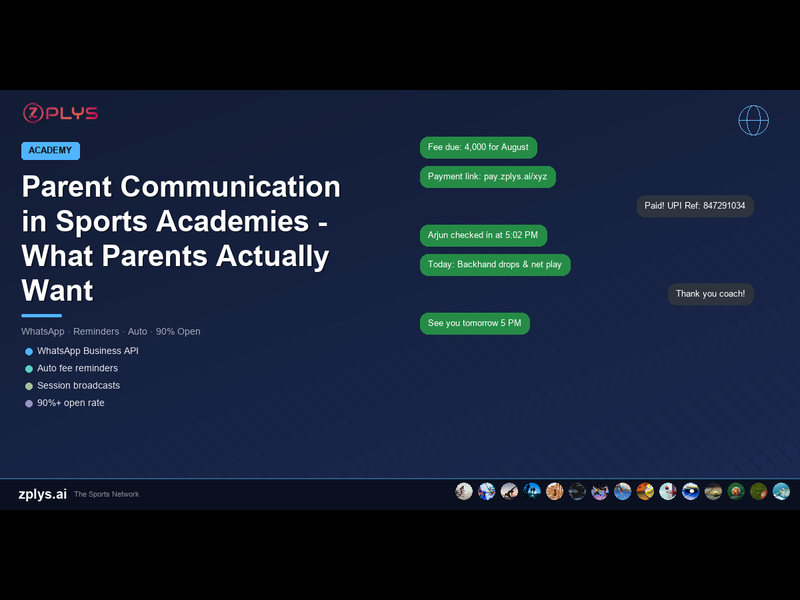
As your academy grows beyond 80-100 students, manual communication becomes unsustainable. This is where tools like Zplys help - automated fee reminders, batch-wide announcements, and progress tracking that parents can access anytime. But always supplement automation with personal touchpoints. A monthly voice note from the coach to each parent takes 2 minutes and is worth more than any automated notification.
The academies that grow to 500 or 1000 students treat parent communication as a core business function - not an afterthought.